
Silicone Technology for Coating Buildings | Buenos Aires
Application of Silicone Membrane to Concrete Industrial Building
EndurisTM Roof Coating and SilshieldTM Architectural Coating were applied throughout the entire exterior and interior (surface area of 19,500 m2) of a prefabricated concrete industrial building located in Buenos Aires, Argentina.
The building manager needed to meet two objectives: increase the useful life of the building and facilitate future maintenance operations. To do so, he decided to use our 100% alkoxy silicone coatings due to their ease of application and long-term performance benefits.
Additionally, our silicone coatings had offered up to fifteen years of protection on the roofs of other industrial buildings similar to that of the client. The membranes had demonstrated excellent UV resistance, and had also preserved their elasticity and resistance to standing water.
General Project Information
The industrial building is located in Don Torcuato Partido de Tigre, Buenos Aires province, and it is used for various production activities.
The industrial building’s ground surface is 70 x 50 m2 and its open interior height is 10m. The building was built between 2020 and 2021.
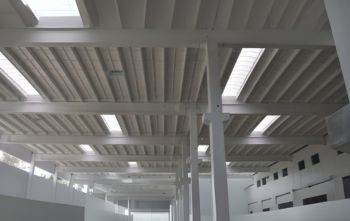
As observed in the photos below, the system was built using columns, beams, and slabs made of prefabricated structural concrete.
The application took place in November and December 2020 and January and February 2021. The relative humidities and temperature ranges confirmed during implementation of the project were as follows:
- Temperature range: 20 to 30°C
- Relative humidity range: 60 to 70%
Table of Surfaces
The surfaces of the building that were protected with Enduris 3500 totaled 19,500 m² based on the following details:
| Surface Exterior (m²) | Surface Interior (m²) | |
|---|---|---|
| Exterior horizontal roof | 3,600 | - |
| Vertical interior and exterior walls | 2,400 | 2,400 |
| Interior “headroom” surfaces | - | 11,100 |
| Total (m²) = | 6,000 | 13,500 |
Building Substrates
The substrates of the building where the silicone membrane was applied are as follows:
- Substrate #1: Prefabricated structural concrete – on columns, beams, and slabs
- Substrate #2: Light mortar – used to repair walls
- Substrate #3: Rigid polyurethane foam – applied to roof beams
Some relevant characteristics of the building's wall and roof substrates are detailed below:
| Substrate #1 Structural concrete | Substrate #2 Light mortar | Substrate #3 PU foam spray | |
|---|---|---|---|
| Resistance (kg/cm²) | 210 (99% of area) | 60 to 80 (reparaciones puntuales) | - |
| Surface texture | Exterior walls: smooth, Columns and beams: more rough | Generally smooth | Average roughness of the PU foam |
| Porousness | Very low | Low | Closed-cell foam |
| Density (kg/m³) | - | - | 35 |
Surface Preparation
The prefabricated concrete walls and beams had been manufactured over one year prior and were dry and free from contaminants. They also did not have any fissures.
In preparing the concrete (substrates #1 and #2), surface cleaning was done to eliminate existing dust. However, they were not power washed and no other special preparation was done.
Our 100% silicone liquid membranes adhered well to the concrete. No errors occurred during application.
Method of Application
Two application methods were used when applying the silicone:
| Application with airless equipment | This was used on the interior and exterior walls, beams, and columns. It was also used on the “headroom” surfaces (subfloor and storehouse). The silicone membrane was applied in two coats in order to achieve a better aesthetic finish (with 4 hours of drying between coats). |
| Application with roller | This was used on the exterior roof of the building, which had a layer of PU spray. The silicone membrane was applied with one coat, in three steps:
|
| Thickness | To offer 10-year protection, a dry thickness of 21 mils was used for the roof, and 10 mils for vertical walls. |
Conclusions
- Our “alkoxy” 100% silicone liquid membranes adhered well to the concrete. No errors occurred during application.
- The silicone membrane was applied to the roof with rollers and was easily applied.
- Application on walls (interior and exterior) was done using an airless system by a highly experienced user, in order to achieve the right aesthetic appearance. In the case of the interior walls, which do not receive direct sunlight, the application was very uniform.
- Application in “headroom” (interior) areas was done using an airless system; due to its position it required more time and more qualified personnel.
- At the end of the project, the building manager confirmed that the objectives proposed initially were successfully achieved.
Enduris 3500 and Silshield 3100
We have silicone liquid membranes for renovating and protecting roofs (Enduris 3500) and vertical walls (Silshield 3100), which offer great advantages to the user:
- High solid content: Enduris 3500 - 90% and Silshield 3100 - 75%
- Application in one coat, at room temperature
- Optimal adhesion to most substrates without needing primer
- Application using roller and/or airless system
- Excellent resistance to UV radiation and standing water
- Long-term elastomeric behavior
Buenos Aires Industrial Building Restoration
Project Overview
An industrial concrete structure in Don Torcuato, Buenos Aires, spanning 19,500 m2, was restored using EndurisTM Roof Coating and SilshieldTM Architectural Coating. The goal was to extend the structure’s lifespan and ease future maintenance.
Application Details
- 3,600 m2 of PU-foam sprayed exterior roof coated with roller
- 2,400 m2 of vertical exterior walls, and 13,500 m2 of interior ceilings and walls sprayed with airless equipment
- Dry film thickness: 21 mils (roof), 10 mils (walls)
Conditions & Performance
- Temperature: 20–30°C, Humidity: 60–70%
- Excellent adhesion to prefabricated concrete and mortar without primer
- No application errors reported; aesthetic finish achieved with two coats
Conclusion
The GE EndurisTM system met all project objectives, delivering long-term durability and protection from UV, moisture, and structural aging. Aesthetic and structural performance was confirmed through post-application inspection.